BIOGRAPHY

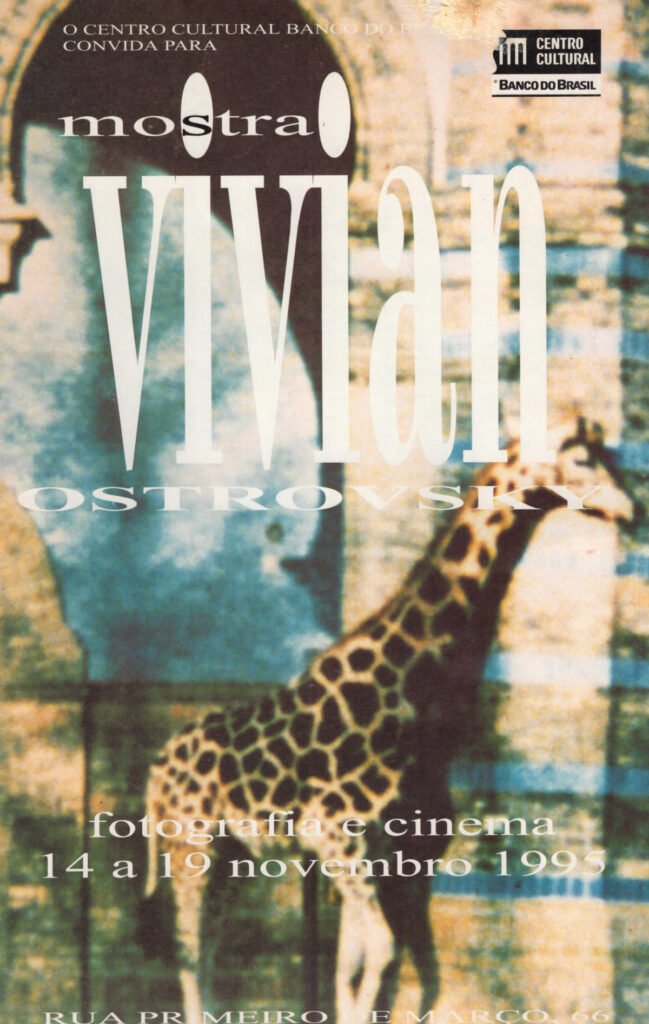
Vivian Ostrovsky is best known for some thirty films, which range from short exuberant montages to diary and portrait meditations to projected installations.
Born in New York and raised in Rio de Janeiro, Vivian studied film at the Sorbonne in Paris, where she studied with Éric Rohmer, and also with Henri Langlois at the Cinémathèque Française. Her art is as multifaceted as her biography. Having initially worked primarily in Super 8, Ostrovsky creates evocative hybrids of experimental genres—such as the found-footage collage, the essay film, and the personal diary—from an eclectic range of source materials. Sound plays an important role in her films. Curator Federico Rossin writes, “Multicultural, multilingual and anti-identitarian by nature, Vivian Ostrovsky insists on mixing genres… Her modus operandi consists of the combination, of poetic, humorous, ethnographic, autobiographical and cinematic visual and sonic ingredients…” Throughout her body of work, Ostrovsky applies a keen observational eye and a sly sense of humor to merge the personal and the political, creating a filmic language that is distinctly her own. Rossin adds: “Combining great humility with breathtakingly precise audiovisual montage, Ostrovsky creates a field of artistic expression that escapes and expands beyond its boundaries… her hybrid cinema refuses to be limited by format or convention; with each new film, she liberates powerful new forms and expands her burgeoning creative practice.”
In the 1980s, before her work as a filmmaker, Ostrovsky was well known in cinema circles for her crucial role in promoting women’s cinema and for championing experimental and avant-garde film. She remains an activist on behalf of the work of others, as a supporter and curator. In addition, she has recently completed a one-hour film, Elizabeth Bishop: From Brazil with Love, which follows the American poet’s 15-plus years in Brazil.
This film joins her growing collection of portrait-essays inspired by women artists, including Japanese poet Sei Shōnagon, French choreographer Mathilde Monnier, Brazilian writer Clarice Lispector, and Belgian filmmaker Chantal Akerman.
CURATORIAL STATEMENT
The quirky, poetic micro-events and rhythms of daily life have been central to Vivian Ostrovsky’s new take on old-school experimental filmmaking. Her directorial expertise spans from uproarious and meditative fugues of found and shot footage to longer-form, inventive, often personal documentaries, and also includes avant-garde portraits of artists and intellectuals and, occasionally, immersive film installations.
Ostrovsky’s films are trans-temporal. Viewers are induced to feel these films vividly, as though they were somehow their own memories. Initially inspired by Jonas Mekas’s diary films, she cultivated an expert flâneur’s kino-eye but moved on to develop this skill into a signature approach driven by editing.
This shift was made not so much to emphasize chronology, content, or structure as to “sculpt” visual logic, which she amplifies with surprising sound effects, bits of vintage music, and sometimes her own soothing, confessional narration. Appropriations of and references to cinema history often imbue her projects with a unique dreamy playfulness and wistful nostalgia. Throughout her diverse portfolio, Ostrovsky’s work is especially notable for its distinctive intimacy.
All along, she has been a devout cinephile and, while building her own maverick body of work, she has proactively supported the work of others as a film distributor, festival organizer, programmer, curator, collector, and sponsor. A champion of Brazilian art and film, Ostrovsky is currently spearheading a restoration project to conserve and remaster art films and videos created before 1980.
An artist and an artist’s artist, Ostrovsky has a reverence for the oldest and newest dimensions of filmmaking. Within and beyond all that, one had best not overlook her irreverent, wry sense of humor, for it infuses all of the above.
Barbara (Kelly) Gordon
Smithsonian curator